Why traditional software development fails FM contractors
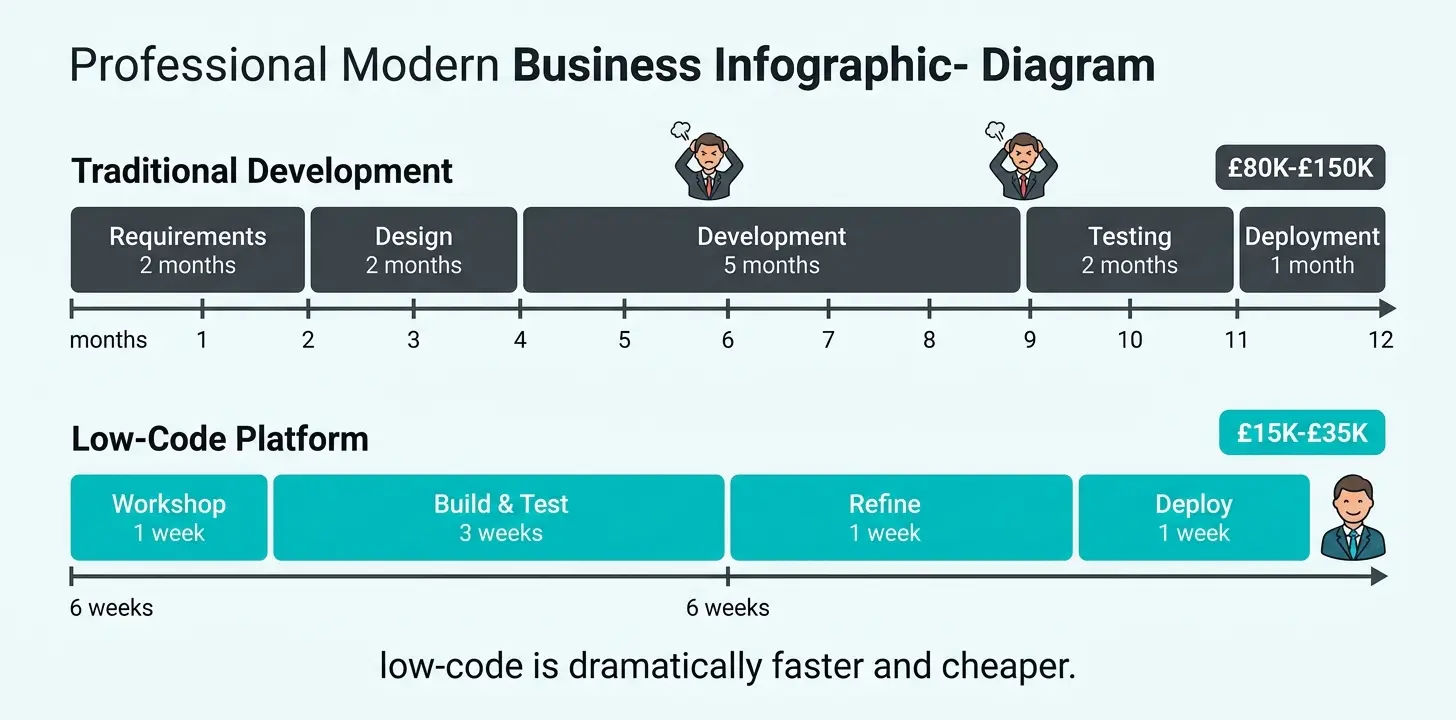
Every FM and construction contractor eventually encounters the same digital transformation barrier: their operational requirements are too specific for off-the-shelf software, but custom development is too expensive and too slow to justify. The business needs a mobile app for engineer job logging, a client portal for real-time visibility, or a contract management system designed around FM workflows — but traditional development quotes come back at £80K–£150K with 9–12 month delivery timelines.
This is the development bottleneck that has blocked digital transformation for mid-market businesses for two decades. The economics never worked. You either bought generic software that did not fit your processes and spent months customising it, or you commissioned custom development that consumed your IT budget for two years and delivered a system that was outdated by the time it launched.
The core problem is not the cost of developers. The problem is the waterfall development model itself:
- Requirements gathering takes 6–8 weeks of workshops and documentation
- Development happens in isolation — you see nothing for 4–6 months
- First working prototype arrives 6 months in, by which time requirements have changed
- Change requests trigger expensive change control processes and timeline extensions
- Final system launches 12–18 months after initial scoping, often missing original business need
- Ongoing maintenance requires retaining expensive developers or vendor support contracts
Mid-market FM contractors cannot afford this model. By the time a custom mobile app for reactive maintenance is delivered 12 months later, the CAFM system it integrates with has been upgraded, the operational team who defined requirements has changed, and the business priorities have shifted. Traditional development is structurally misaligned with the pace of change in operational businesses.
What low-code platforms actually are and how they work
Low-code platforms are not "simplified programming tools for beginners." They are enterprise-grade development environments that use visual designers, pre-built components, and declarative configuration instead of hand-written code to build production-ready business applications. The Power Platform is the dominant low-code platform for businesses already using Microsoft 365.
Here is what changes when you build applications using low-code platforms instead of traditional development:
The fundamental shift is this: traditional development builds everything from first principles. Low-code platforms provide the infrastructure, security, data storage, and common functionality as a platform service. You configure and assemble rather than coding from scratch. This is why Power Apps can deliver in 6 weeks what traditional development takes 6 months to build.
How low-code platforms democratise application development
The most significant impact of low-code platforms is not faster development by professional developers. It is that non-developers can now build production applications. Operations managers, contract administrators, and HSQE leads can create business apps without writing code. This is the democratisation of development — application building is no longer the exclusive domain of IT departments.
Here is what this looks like in practice at FM contractors:
Operations managers building field apps
An operations manager with no coding background uses Power Apps to build a mobile inspection app for PPM engineers. Drag-and-drop form builder, photo capture component, signature control, and connection to existing CAFM system via pre-built connector. Built in 3 days. Deployed to 15 engineers. No IT department involvement required.
Contract administrators automating workflows
A contract administrator builds a Power Automate workflow to automatically generate monthly performance reports. Pulls data from CAFM, finance system, and client feedback forms. Populates Word template. Saves to SharePoint. Emails to client. Entire workflow built using visual designer in 2 hours. Eliminates 6 hours of manual work every month.
HSQE leads creating compliance trackers
An HSQE manager builds a Power Apps database to track gas safety certificates, fire alarm tests, and engineer competencies. Automatic deadline alerts when certificates expire in 30 days. Dashboard showing compliance status across all sites. Built in 1 week without developer assistance. Replaces 15 Excel spreadsheets that were impossible to maintain.
Account managers building client portals
An account manager uses Power Pages to create a client-facing portal showing real-time job status, SLA performance, and compliance certificates. Connected to existing Dataverse database. Portal live in 2 weeks. Client logs in to see their data without requiring CRM access or manual reports. Account manager built entire portal using templates and visual configuration.
This is the paradigm shift. In 2015, every one of these applications would have required professional developers, formal IT projects, and £30K–£80K budgets. In 2026, operational staff build them in days or weeks using visual tools. The constraint on digital transformation is no longer access to developers — it is knowing what problems are worth solving and having basic platform training.
Which business applications are ideal for low-code development
Low-code platforms are not a replacement for all traditional development. They excel at specific types of business applications. Understanding where low-code delivers greatest value versus where traditional development remains necessary is critical to successful digital transformation strategy.
Internal operational applications. Apps used by your employees to manage day-to-day operations are ideal for low-code. Mobile job logging apps, digital inspection forms, approval workflow systems, contract management databases, compliance tracking tools. These apps have well-defined requirements, integrate with existing business systems, and benefit from rapid iteration based on user feedback. Low-code platforms deliver these 5–10 times faster than traditional development.
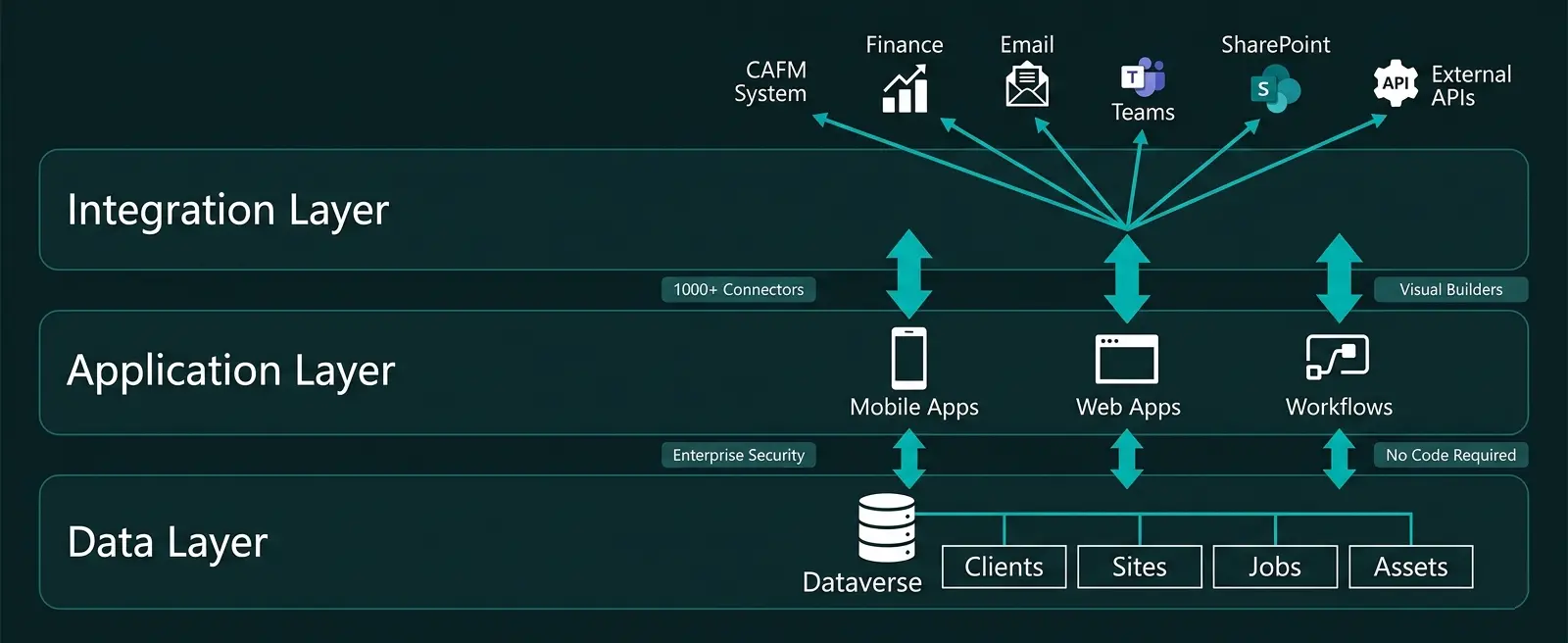
Data integration and automation. Connecting disparate business systems is pure low-code territory. Syncing data between CAFM and finance systems, automating report generation, sending notifications based on database triggers, populating documents from structured data. Power Automate handles these workflows elegantly with visual designers and 1000+ pre-built connectors. Traditional development would write custom API code for each integration — low-code configures existing connectors.
Rapid prototyping and MVP testing. When you need to test a business concept quickly, low-code enables build-measure-learn cycles that are impossible with traditional development. Build a minimal viable product in 2 weeks. Deploy to pilot users. Gather feedback. Iterate. Either scale the solution or abandon it without sunk cost. Traditional development requires 3–6 months before you can test anything with real users.
For FM contractors, 90% of digital transformation requirements fall squarely into low-code territory. You are building internal operational tools, not consumer-facing apps competing with Netflix. The performance requirements are "fast enough for daily use" not "sub-second response at global scale." The UI requirements are "functional and intuitive for engineers" not "award-winning consumer design." Low-code platforms are purpose-built for exactly this type of business application.
What FM contractors are actually building with low-code platforms
Low-code platforms are not theoretical. FM and construction contractors are deploying production applications built on Power Platform across their operations. These are real systems handling real workloads today:
Mobile reactive maintenance system
Custom Power App replacing paper job sheets. Engineers receive job notifications on mobile, complete digital forms on site with photo evidence and signature capture. Job status syncs to CAFM system automatically. Client portal updates in real-time. Built in 6 weeks for £24K. Eliminated 18 hours weekly admin overhead.
Site mobilisation workflow system
Multi-stage approval workflow for new contract mobilisations. Captures site details, health and safety requirements, resource allocation, client contacts. Routes through operations, HSQE, commercial, and client for approvals. Generates mobilisation checklist and timeline automatically. Built in 4 weeks for £18K. Reduced mobilisation time from 6 weeks to 3 weeks.
Custom CRM for FM contracts
Bespoke Power Apps CRM replacing spreadsheet-based client tracking. Manages client hierarchy (clients → contracts → sites → buildings), opportunity pipeline, contract performance tracking, renewal alerts. Integrates with CAFM and finance systems. Built in 10 weeks for £28K. Replaced £45K/year SaaS CRM licences.
Compliance certificate management
Digital system replacing paper compliance filing. Tracks gas safety certificates, fire alarm tests, legionella risk assessments, engineer competencies. Automatic email alerts 30/14/7 days before expiry. Escalates to HSQE manager if no action. Client portal shows compliance status. Built in 5 weeks for £16K. Eliminated all missed certificate renewals.
Shared pattern: All these applications would have cost £60K–£120K and taken 9–15 months using traditional development. Low-code delivery in 4–10 weeks at £15K–£30K is not theoretical — it is happening at FM contractors across the UK today. The economic advantage of low-code for business applications is overwhelming.
Why the "skills shortage" objection misses the point
The most common objection to low-code adoption is "we don't have people with Power Apps skills." This objection misunderstands what low-code platforms enable. The entire purpose of low-code is to eliminate the requirement for traditional development skills. The barrier to building business applications is no longer coding ability — it is business process understanding and basic platform training.
"We don't have developers on staff"
Reality: Low-code platforms are designed for business users, not developers. An operations manager with no coding background can build a functional mobile app after 2 days of Power Apps training. The learning curve is hours, not years. You do not need permanent developers to use low-code platforms.
"We can't find Power Apps talent to hire"
Reality: You train existing staff, you do not hire specialists. Your operations manager who understands FM workflows is more valuable than an external Power Apps developer who does not know your business. Platform training takes days. Business domain knowledge takes years. Train the people who know the problems.
"Low-code skills are not transferable"
Reality: Power Platform is Microsoft's strategic low-code platform with millions of users globally. Power Apps skills are highly transferable across industries. Training staff on Power Platform increases their market value and reduces attrition risk. This is professional development, not vendor lock-in.
"We need expensive consultants to build anything"
Reality: Power Platform partners build your first 2–3 applications and train your team simultaneously. By application 3–4, your staff are making changes and building new apps independently. The goal is capability transfer, not dependency creation. Good partners make themselves redundant.
"Our IT team does not have capacity to support this"
Reality: Low-code platforms reduce IT dependency, they do not increase it. Operations teams build and maintain their own apps without IT tickets. IT establishes governance (who can create apps, data security rules) but does not write or maintain the apps. This frees IT capacity rather than consuming it.
"Business users will build unmaintainable applications"
Reality: Platform governance enforces standards — naming conventions, security policies, data structure patterns. Poor-quality apps are easy to identify and fix because everything is visual. Contrast with custom code where only the original developer understands the implementation. Low-code actually reduces maintenance risk.
The paradigm shift is this: traditional development requires specialist skills that take years to acquire. Low-code platforms require business process understanding (which your operational staff already have) plus basic platform training (which takes days or weeks). The skills barrier has been removed. The constraint is no longer technical capability — it is knowing what problems are worth solving and having the confidence to try.
When to build custom low-code apps versus buying off-the-shelf software
Low-code platforms do not eliminate the build versus buy decision. They change the economics radically enough that "build custom" is now viable for use cases where it was previously unaffordable. Understanding when to build versus when to buy is critical to digital transformation success.
- Core business systems with mature vendor ecosystems (accounting, payroll, CAFM)
- Commodity functionality every business needs identically (email, document storage, video conferencing)
- Your requirements genuinely match standard product capabilities without heavy customisation
- Vendor provides regular updates and compliance with evolving regulations
- You have no internal capability or appetite to maintain custom applications
- Off-the-shelf cost is lower than custom build when 3-year TCO considered
- Industry-specific workflows that generic software does not handle well (FM contract management, tender tracking)
- Integration-heavy applications connecting multiple existing systems
- Departmental tools with niche requirements (compliance tracking, site mobilisation workflows)
- Processes that change frequently requiring rapid iteration capability
- Off-the-shelf options exist but require expensive customisation to fit your process
- Custom build cost is 50%+ lower than configured off-the-shelf over 3 years
The critical insight is that low-code has shifted the economic threshold. In 2015, "build custom" required £80K+ investment, making it viable only for the most critical business-differentiating applications. In 2026, custom build costs £15K–£35K, making it economically rational for departmental tools and niche workflows that would never have justified traditional development budgets.
The hybrid approach. Most successful FM contractors run a mixed estate: off-the-shelf core systems (CAFM, finance, HR) integrated with custom low-code applications (mobile field apps, digital workflow systems, client portals). The commercial CAFM handles asset registers and PPM scheduling. The custom Power App handles reactive job logging and signature capture. Power Automate syncs data between them. This is the optimal architecture — best-of-breed vendors for commodity functions, custom low-code for differentiated workflows.
How to start your low-code digital transformation journey
Low-code adoption follows a proven maturity curve. FM contractors who execute digital transformation successfully follow this sequenced approach rather than attempting wholesale platform rollout:
Platform training foundation
Train 2–3 operational staff (operations manager, contract administrator, HSQE lead) on Power Apps and Power Automate basics. 2-day workshop covering data models, form design, workflow logic. Cost £2K–£4K. Creates internal capability.
First pilot application
Engage Power Platform partner to build first production app (mobile job logging, compliance tracker, approval workflow). Partner builds while training your team. App delivered in 4–8 weeks. Cost £12K–£25K including training.
Measure and validate ROI
Track time saved, approval cycle reduction, or admin overhead eliminated. Typical first app delivers 10–20 hours weekly time saving. ROI period 3–6 months. Proves business case for wider adoption.
Build internal capability
Trained staff build second application with partner oversight. Partner provides technical review and guidance but staff drive development. Capability transfer accelerates. Staff confidence increases.
Establish governance
Define who can create apps, data security policies, naming conventions, and approval process for production deployment. Governance prevents chaos as platform adoption scales. IT establishes guardrails without controlling development.
Scale across departments
Operations builds mobile field apps. Commercial builds tender tracking. HSQE builds compliance management. Finance builds invoice approval workflows. Platform adoption spreads organically as teams see results from early adopters.
Centre of Excellence model
Establish community of practice — internal Power Platform users sharing patterns, templates, and knowledge. Monthly showcase sessions where departments demo new apps. Collective capability compounds.
Strategic platform leverage
Low-code becomes default approach for business application needs. "Should we buy software X or build it on Power Platform?" is evaluated routinely. Platform capability drives competitive advantage through faster innovation cycles.
Most FM contractors progress from step 1 to step 6 within 12–18 months. The maturity curve is predictable: initial scepticism → pilot success → wider adoption → embedded capability → competitive advantage. The businesses that started low-code adoption in 2023–2024 are now at step 7–8. Those starting in 2026 are 18–24 months behind.
Digital transformation is no longer limited by technical capability
The democratisation of development through low-code platforms has fundamentally changed what is possible for mid-market FM and construction contractors. Applications that required £80K budgets and 12-month timelines in 2015 now deploy in 6 weeks for £20K. More significantly, applications that would never have justified traditional development investment are now economically viable.
This is not incremental improvement. This is a paradigm shift in digital transformation economics. The constraint is no longer access to developers or IT budget. The constraint is knowing what operational problems are worth solving and having the organisational confidence to build rather than buy when custom solutions deliver better fit.
FM contractors who embrace low-code platforms in 2026 gain compounding advantages. They build internal platform capability that accelerates over time. They iterate on applications weekly rather than waiting months for vendor updates. They redirect spend from software licences to business-specific tools that deliver competitive differentiation. They move faster than competitors still locked into waterfall IT projects or generic SaaS platforms that do not fit FM workflows.
The businesses waiting for "more mature" low-code platforms or "clearer vendor direction" have already missed the window. Power Platform crossed the enterprise-ready threshold in 2020. The early adopters are now 3–4 years ahead in platform maturity and internal capability. The gap widens every quarter as their capability compounds and late adopters remain dependent on expensive vendors and slow IT projects.
Digital transformation in 2026 is not about budget or technical skill. It is about strategic choice. Will your business build the operational tools that match your specific workflows, or will you continue forcing your processes into generic software designed for everyone and optimised for nobody? Low-code platforms have removed the technical and economic barriers. The only remaining question is whether your business will lead the transformation or follow it.
Ready to replace your spreadsheets?
Book a free 60-minute discovery call and we will show you what is possible for your business.
Book a Discovery Call →