The hidden cost of running FM operations on paper
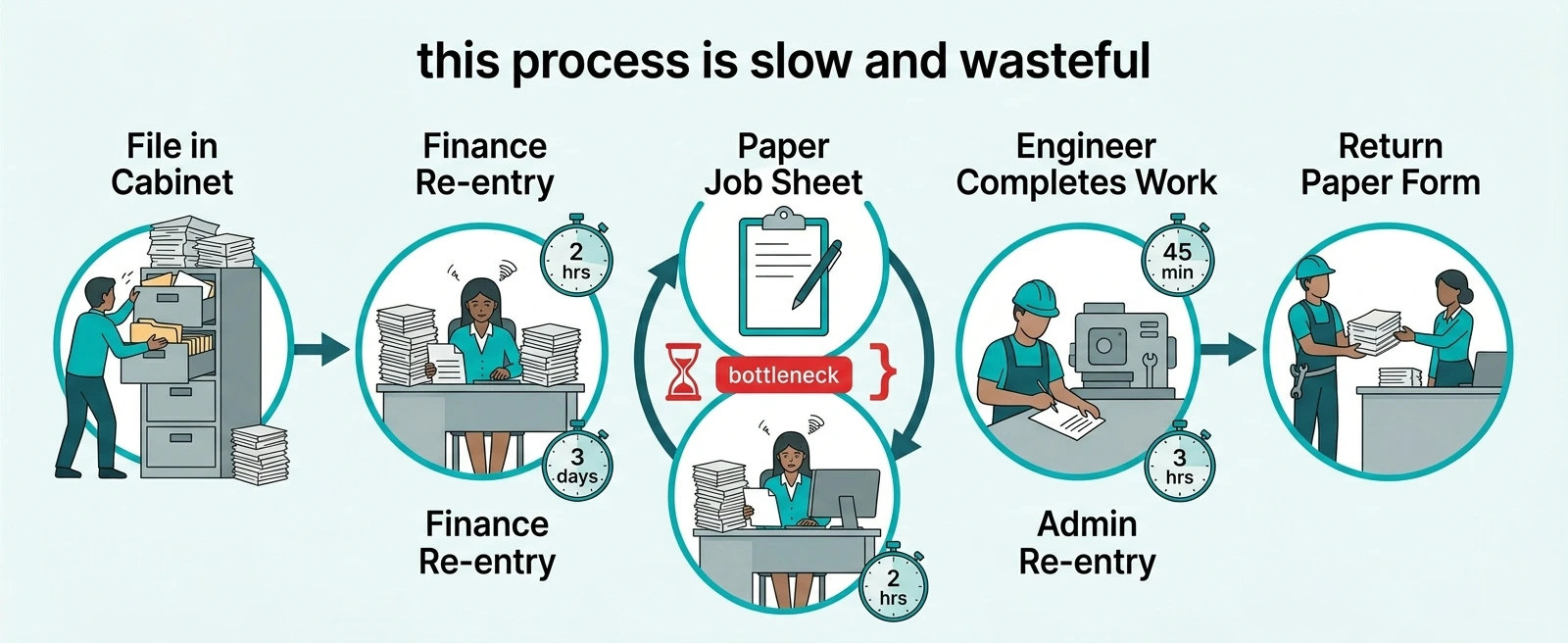
Every FM contractor recognises the pattern. Engineers arrive on site at 8am, collect a printed job sheet from the van, complete the work by midday, return the paper form at 5pm. An administrator spends the next morning manually typing the completion data into the CAFM system. The finance team re-enters the same data three days later to raise an invoice. The client calls on Friday asking for an update on a job that was finished on Tuesday — but nobody has entered it yet.
This is not an edge case. This is how most mid-sized FM, construction and manufacturing operations still run in 2026. Paper job sheets, printed permits to work, manual timesheets, and physical compliance certificates remain the operational backbone of thousands of businesses across the UK.
The problem is not that paper forms do not work. They do. The problem is the hidden tax they impose on every transaction:
- Engineers spend 45 minutes per day travelling back to depot to drop off paperwork
- Administrators re-enter 80–120 paper forms per week into digital systems
- Compliance certificates get filed in lever arch folders nobody ever opens again
- Client queries take hours to answer because data exists only on paper in someone's van
- Audit trails are impossible — "we definitely did that gas safety check" is not evidence
- Real-time visibility does not exist — you know what happened yesterday, not what is happening now
The cumulative cost is not measured in paper and ink. It is measured in lost capacity, delayed invoicing, compliance risk, and the operational friction that prevents businesses from scaling efficiently.
Why 2026 is the tipping point for FM digitisation
The technology to replace paper forms with digital workflows has existed for over a decade. So why are FM contractors finally making the shift in 2026? Three converging forces have turned digitisation from a "nice to have" into an operational imperative:
Offline mobile capability is now standard
The historic blocker for field digitisation was connectivity. Engineers working in basements, remote sites, or areas with poor signal could not use cloud-based apps. Modern mobile platforms like Power Apps now support full offline functionality — engineers can log jobs, capture photos, and complete forms without any signal. Data syncs automatically when connectivity returns. The technical barrier has been removed.
Client expectations have permanently shifted
Facilities management clients now expect real-time visibility as standard. They want live dashboards showing job status, SLA performance, and asset compliance — not monthly PDF reports generated from spreadsheets. Contractors still operating on paper are losing tenders to competitors who can provide digital client portals and real-time data. The market has moved.
Regulatory compliance demands are escalating
Building Safety Act enforcement, Hackitt Report recommendations, and stricter fire safety regulations are raising the compliance burden on FM contractors. Paper-based compliance tracking is no longer defensible. Auditors and building safety managers require digital audit trails, automated deadline alerts, and instant access to certification history. Paper certificates in filing cabinets do not meet the standard.
The convergence of these three factors — technical capability, market expectation, and regulatory pressure — means that 2026 is the year when running operations on paper stops being viable. The question is no longer "should we digitise?" but "how quickly can we execute the transition?"
What digital workflows actually mean in practice
Digital workflows are not simply "the same paper forms, but on a tablet." That is digitisation theatre — creating a PDF of a paper form and displaying it on a screen. Real digital workflows eliminate the form entirely and replace it with structured data capture that flows automatically into your operational systems.
Here is what changes when you move from paper to a properly designed digital workflow:
- Engineer receives printed job sheet at depot in morning
- Manually records completion details on paper form
- Returns paper form to office at end of day
- Administrator re-enters data into CAFM system next morning
- Finance team manually creates invoice from CAFM data
- Paper form filed in cabinet, never accessed again
- Client has no visibility until monthly report generated
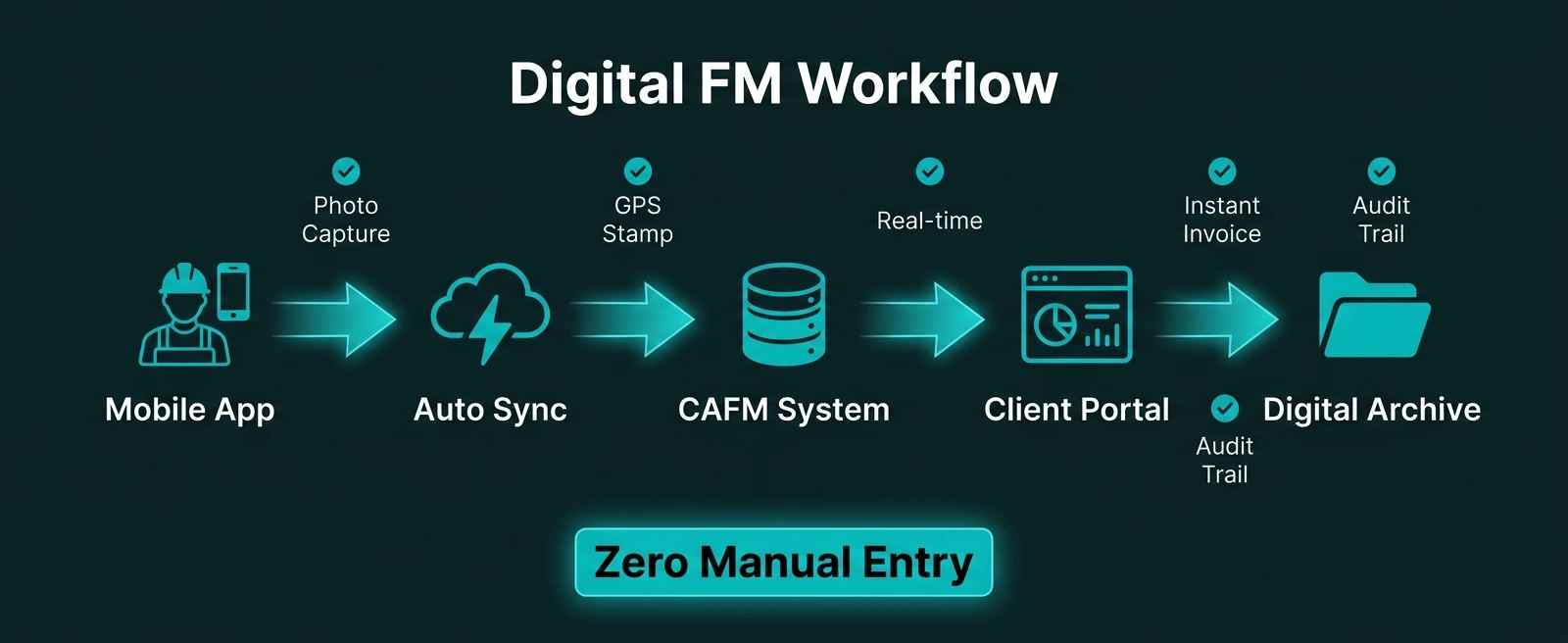
- Engineer receives job notification on mobile app automatically
- Completes digital form on site with photos and signature capture
- Data syncs to CAFM system instantly when back online
- Client portal updates in real-time showing job complete
- Invoice auto-generated from digital completion data
- Compliance dashboard updates with certificate expiry tracking
- Full audit trail with timestamps, GPS location, and photos stored permanently
The difference is not cosmetic. Paper processes involve multiple manual handoffs and data re-entry. Digital workflows capture data once at source and distribute it automatically to every system that needs it. The result is faster invoicing, better compliance evidence, real-time client visibility, and significantly reduced admin overhead.
Five high-volume workflows FM contractors digitise first
Most FM contractors do not attempt to digitise every workflow simultaneously. They start with the highest-volume, highest-pain processes where digital workflows deliver immediate measurable return. These five workflows are consistently the starting point:
Reactive maintenance job sheets
Replace paper job sheets with mobile digital forms. Engineers receive job details on their phone, complete work, capture photos of completed work, and collect digital signatures on site. Job status updates automatically in the CAFM system and client portal without any manual data entry.
Permit to work and RAMS
Digital permit-to-work forms with mandatory safety checks, hazard identification, and multi-level approval workflow. Cannot proceed until all sign-offs complete. Full audit trail of who approved what and when. Instantly accessible for compliance audits rather than buried in filing cabinets.
Planned maintenance inspections
Replace paper PPM checklists with structured digital inspection forms. Engineers complete checks on mobile with photo evidence of defects, automatic failure flagging, and instant work order generation for remedial actions. Compliance certificates auto-generated with full inspection history attached.
Engineer timesheets and expenses
Digital timesheet capture tied directly to job records. Engineers clock in/out per job on mobile app. Time automatically allocated to correct client and contract. Eliminates weekly paper timesheet submission and manual payroll data entry. Expense receipts photographed and submitted instantly rather than collected monthly.
Shared pattern: All these workflows involve field engineers capturing data that currently exists only on paper and must be manually re-entered into office systems. Digitising these four processes alone typically eliminates 15–25 hours of admin time per week in a 20-engineer operation.
Measurable ROI: what changes when you eliminate paper workflows
The return on investment from digitising operational workflows is not abstract. It shows up in four measurable areas that directly impact profitability:
Admin Time Saved Per Week
Typical time reclaimed when paper forms are replaced with digital workflows in a 20-engineer FM operation
Faster Invoice Cycle
Reduction in time from job completion to invoice raised when data flows automatically from field to finance
Annual Saving Per 20 Engineers
Typical cost reduction from eliminated admin time, faster cash collection, and reduced compliance risk
Faster cash conversion. The single biggest financial benefit is accelerated invoicing. When job completion data flows automatically from the mobile app to the finance system, invoices are raised the same day rather than 7–10 days later. For a £2M turnover FM contractor, bringing forward invoice raising by one week improves cash flow by approximately £38K.
Reduced compliance risk. Paper-based compliance tracking is a liability. Gas safety certificates stored in filing cabinets cannot alert you when renewal is due in 14 days. Digital workflows with automated deadline monitoring and escalation eliminate missed renewals and the associated regulatory risk. The cost of a single HSE enforcement notice far exceeds the cost of digital transformation.
Improved client retention. Clients increasingly expect real-time visibility into contractor performance. Digital workflows enable live dashboards showing job status, SLA compliance, and asset health. This level of transparency strengthens client relationships and significantly improves contract renewal rates. One national FM contractor reported that introducing client portals improved retention from 73% to 89% over two years.
Operational scalability. The long-term benefit is leverage. When you win new contracts, your admin overhead does not scale linearly with engineer headcount. Digital workflows handle increased volume without requiring proportional admin team growth. This is the difference between profitable growth and growth that erodes margin.
Common objections to going paperless — and the reality
Every FM contractor considering digital workflows raises similar concerns. Here is what the objections sound like and what the reality is once systems are deployed:
"Engineers won't use apps — they prefer paper"
Reality: Engineers resist change to their routine, not technology itself. They all use smartphones daily. Properly designed mobile apps with offline capability and intuitive interfaces see 95%+ adoption within two weeks when implementation includes basic training and management expectation-setting.
"We work on sites with no mobile signal"
Reality: Modern platforms like Power Apps support full offline mode. Engineers complete digital forms without connectivity. Data syncs automatically when signal returns. Offline capability is now standard, not a premium feature.
"Digital systems are expensive to build"
Reality: Custom-built systems were expensive a decade ago. Low-code platforms like Power Platform allow businesses to build production-ready mobile apps and workflows for £15K–£35K including deployment. ROI period is typically 6–14 months for mid-sized operations.
"Our CAFM system can't integrate with mobile apps"
Reality: Every major CAFM platform has API connectivity. Power Platform includes 1000+ pre-built connectors and supports custom API integration. Legacy system integration is standard practice, not a blocker.
"We need paper for audit and compliance"
Reality: Digital records with timestamps, GPS location, and photo evidence provide stronger audit trails than paper forms. Auditors prefer digital compliance systems because they can instantly verify certificate histories and deadline tracking. Paper is the weaker evidence format.
"Implementation will disrupt operations"
Reality: Phased rollout models minimise disruption. Start with one workflow (e.g., reactive jobs) with a pilot team of 3–5 engineers. Prove it works, train the wider team, then expand to other workflows. Most FM contractors complete full deployment in 8–16 weeks without operational impact.
The pattern is consistent: perceived blockers to digital transformation are either outdated technical limitations that no longer exist, or change management challenges that are resolved through proper implementation planning. The actual barrier is inertia, not capability.
How to move from paper to digital workflows in 12 weeks
Digital transformation does not require a multi-year programme. Most FM contractors execute the transition from paper to digital workflows in 8–16 weeks using a phased rollout model. Here is the proven implementation path:
Identify pilot workflow
Choose one high-volume workflow to digitise first — typically reactive maintenance jobs. Select 3–5 engineers for pilot deployment.
Map current process
Document every step of the existing paper workflow including handoffs, data entry points, and where delays occur. This becomes your digitisation blueprint.
Build and test mobile app
Design digital forms using low-code tools like Power Apps. Test offline functionality, photo capture, and data sync with pilot engineers in real conditions.
Integrate with CAFM and finance
Connect mobile app to your CAFM system and finance package using APIs. Automate data flow so completion data updates systems automatically without manual entry.
Run pilot for 2–4 weeks
Deploy to pilot team. Monitor adoption, gather feedback, fix issues. Measure admin time saved and invoice cycle improvement.
Train wider team
Roll out to all engineers with structured training sessions. Pilot team members act as champions helping colleagues adopt the new system.
Decommission paper process
Once digital adoption reaches 90%+, stop printing job sheets. Remove the fallback option. Teams adapt within days when paper is no longer available.
Expand to next workflow
Apply lessons learned to digitise permit-to-work, PPM inspections, and timesheets using the same phased approach.
Most FM contractors complete steps 1–7 for their first workflow within 8–12 weeks. Once the first digital workflow is proven, subsequent workflows deploy faster because the platform, integration, and team capability already exist. Full digitisation of core operational workflows is typically complete within 6 months.
The cost of waiting is now higher than the cost of change
The decision to move from paper to digital workflows is no longer a technology question. The platforms exist, offline capability is standard, integration with legacy systems is proven, and the ROI is measurable within months. The question is one of timing and urgency.
For FM contractors still running operations on paper in 2026, the cost of inaction is escalating rapidly. Clients are awarding contracts to competitors who can provide real-time digital visibility. Regulatory bodies are enforcing compliance standards that paper-based tracking cannot meet. Engineers are leaving businesses that force them to work with outdated tools when they know better alternatives exist.
The businesses that execute digital transformation now gain a 12–18 month operational advantage over competitors who delay. That advantage compounds — better client retention, faster invoice cycles, lower admin overhead, and the ability to scale operations profitably. By the time late adopters catch up in 2028, the market leaders will have moved even further ahead.
The technology barrier has been removed. The economic case is proven. The market expectation has shifted. The only remaining question is whether your business will lead the transition or follow it.
Ready to replace your spreadsheets?
Book a free 60-minute discovery call and we will show you what is possible for your business.
Book a Discovery Call →