Why paper-based site documentation creates delays on construction projects
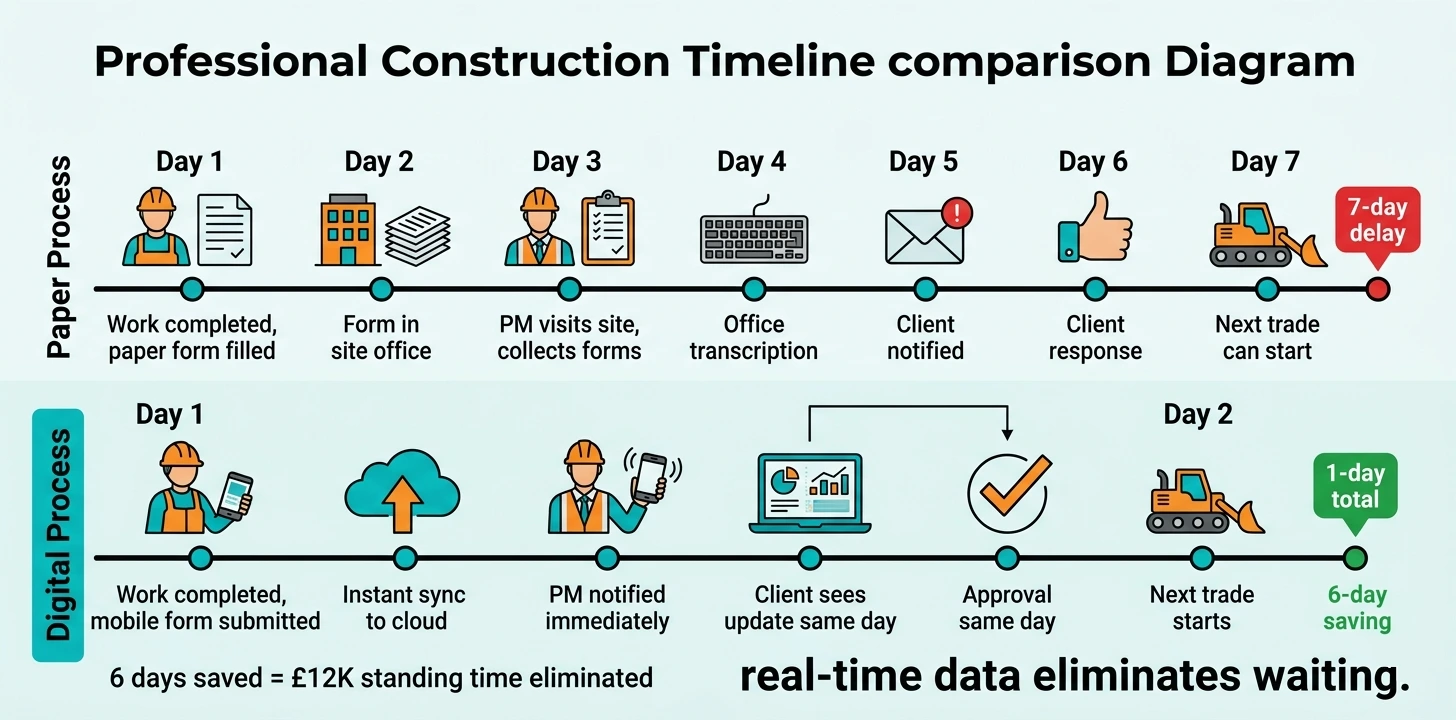
A subcontractor completes foundation work on Tuesday afternoon. The site diary documenting completion sits in the site office. The main contractor's project manager visits site Thursday morning, sees the handwritten entry, returns to office, types notes into project management system, emails update to client and architect. Client responds with queries Friday. Project manager cannot answer without returning to site to check original paperwork. Architect approval delayed until Monday. Next trade (groundworks) was scheduled to start Thursday but cannot commence without sign-off. Four-day delay. £18K in standing time costs. Contractual milestone missed. Penalty clause triggered.
Every day lost to information lag compounds. Paper site diaries, inspection checklists, snag lists, handover documentation, safety briefings, material deliveries, progress photos — all captured on paper, filed in site cabins, transcribed later into digital systems. The lag between work completion and information availability creates systematic delays:
- Site progress updates delayed 24–72 hours while paper forms travel from site to office for manual data entry
- Client queries cannot be answered in real-time because source documentation is on-site in filing cabinets
- Quality inspections recorded on paper require office transcription before architects/engineers can review
- Snag lists compiled on clipboards need manual typing before trades can action remedial work
- Photo evidence stored on personal phones disconnected from inspection records — impossible to match images to specific issues
- Multi-signature approvals (site manager → contracts manager → QS → client) require physical document circulation — 3–7 day lag typical
- Material delivery records on paper mean procurement cannot verify stock levels without site visit or phone call
The cumulative impact on construction programme timeline is measurable. Industry data shows paper-based documentation processes add 8–12% to project duration through information delays, rework from transcription errors, and waiting time for approvals. A 20-week construction programme extended by 2 weeks purely from administrative lag. Client dissatisfaction increases. Profit margins compress. Competitors operating digitally deliver faster.
How mobile digital forms eliminate information lag on construction sites
Mobile digital forms built on Power Apps capture site data directly into cloud systems from smartphones and tablets. No paper. No transcription. No delay. Site manager completes daily diary on tablet at 4pm. Data syncs instantly to SharePoint. Project manager sees update on desktop before leaving office. Client dashboard shows progress update same day. Architect reviews inspection photos within hours. Approval decisions made same day. Next trade starts on schedule.
Here is what changes operationally:
- Site manager fills paper daily diary at end of day
- Form filed in site office cabinet
- Project manager visits site Friday, collects week's paperwork
- Returns to office Monday, transcribes handwritten notes into system
- Emails summary to client and design team Tuesday
- Client has questions Wednesday — PM must retrieve original paper to answer
- Information lag: 5–7 days from work completion to stakeholder visibility
- Photos on site manager's phone disconnected from diary records
- Site manager completes digital diary on tablet/phone at end of day
- Form includes dropdown selections, mandatory photo uploads, GPS location stamp
- Submit button syncs data instantly to SharePoint/Dataverse
- Project manager receives notification, reviews same evening on desktop or mobile
- Client portal dashboard updates automatically showing daily progress
- Design team sees inspection photos and comments in real-time
- Information lag: zero — all stakeholders see updates within minutes of capture
- Photos embedded directly in digital records with automatic timestamp and location
The transformation is from asynchronous batch updates (weekly paper collection and transcription) to continuous real-time data flow. Site teams work exactly as before — filling forms on mobile devices instead of clipboards — but downstream impact is revolutionary. Decision-making speed increases 5–10× when stakeholders access current information continuously rather than waiting for weekly summaries.
Five critical construction processes where digital forms prevent project delays
Digital mobile forms deliver greatest impact on construction project timelines when applied to documentation workflows that currently create waiting time:
Daily site diaries with instant client visibility
Site manager completes daily diary on tablet: work completed today, materials used, weather conditions, labour on-site, issues/delays, tomorrow's plan. Mandatory photos uploaded (progress shots, issues identified). Form syncs to cloud instantly. Client dashboard auto-updates showing daily progress. Email digest sent to client/design team each evening. Eliminates weekly catch-up meetings and "what's happening on-site?" queries. Client visibility continuous instead of weekly.
Quality inspections with immediate architect review
Inspector completes inspection checklist on mobile: foundation depths, concrete pour quality, formwork alignment, reinforcement placement. Pass/fail for each check. Photos mandatory for any failures. GPS location and timestamp auto-captured. Inspection syncs to cloud. Architect receives notification within minutes, reviews inspection and photos remotely. Approval issued same day via mobile signature. Contractor proceeds without waiting for paper inspection to reach design office. 3–5 day approval delay eliminated.
Snag lists with instant trade notification
Client rep walks site pre-handover identifying snags. Records each issue on mobile: description, location, responsible trade, priority, photo evidence. Submits snag list digitally. Power Automate workflow automatically routes each snag to correct trade via email/Teams notification. Trades receive actionable snag items same day with photos and location details. Remedial work scheduled immediately. Client receives progress updates as trades complete fixes. Handover delays reduced 60–70% when snag identification and trade notification happen simultaneously.
Material deliveries with live stock visibility
Site foreman receives material delivery. Scans delivery note barcode, confirms quantities on mobile form, uploads photo of materials on-site. Delivery record syncs instantly to central system. Procurement sees stock levels update in real-time. QS verifies delivery against order. Supplier invoice matched automatically. Eliminates phone calls asking "has delivery arrived?" and "how much stock on-site?". Material ordering decisions made with current data instead of week-old information. Prevents over-ordering and delays from stockouts.
Site handover with digital completion packs
Project reaches practical completion. Rather than compiling paper O&M manuals, warranties, certificates, test results, as-built drawings into physical folders, digital handover pack assembled automatically from documents uploaded throughout project. Client receives link to SharePoint site containing all handover documentation organised by system/area. Building control, warranties, commissioning certificates all accessible digitally. Handover process time reduced from 3–4 weeks (collating paper documents) to 3–4 days (assembling digital pack from already-captured data).
Shared pattern: All five workflows eliminate delay caused by information lag. Site data captured digitally syncs instantly to stakeholders who can review and approve remotely without waiting for paper to circulate. Decision-making happens same day instead of next week. Programme compression from real-time information flow typically delivers 8–15% reduction in project duration.
Why construction site mobile apps must work offline without internet connectivity
Construction sites frequently have poor or zero mobile internet connectivity. Site basements, steel-framed structures, remote locations, temporary site cabins — all create connectivity dead zones. Mobile forms that require constant internet connection fail on construction sites. Forms cannot be submitted. Work stops waiting for connectivity. Site teams revert to paper because digital forms "don't work."
Offline-capable Power Apps solve this deployment barrier. Form data captured locally on device storage even with zero connectivity. Site manager completes daily diary in basement with no signal. Form saves to device. When device reconnects to internet (leaving site, returning to office, WiFi in site cabin), data syncs automatically to cloud. Zero manual intervention required. Site teams never encounter "cannot submit — no connection" failure.
Offline capability is difference between digital forms that work on construction sites versus digital forms that get abandoned for paper after first connectivity failure. The implementation requirement is absolute: if mobile app requires internet to function, it will not be adopted on construction sites.
How to deploy mobile digital forms without disrupting construction operations
Construction site digital transformation succeeds when forms mirror existing paper processes rather than forcing new workflows. Site teams adopt digital when it makes their work easier, not when it requires learning new procedures:
Digitise existing paper forms exactly
Take current paper site diary, inspection checklist, snag list. Recreate digital version field-for-field. Do not "improve" workflow yet — just digitise what exists. Site teams recognise familiar format, adopt easily.
Add mandatory photo uploads
Require photos for key form sections: progress shots in daily diary, issue evidence in inspections, snag photos in defect lists. Photos auto-embed with location and timestamp. Eliminates disconnected photos on personal phones.
Build offline capability from start
Configure Power Apps offline profile: which data tables cache locally, sync frequency, conflict resolution rules. Test in zero-connectivity environment before site deployment. Offline must work flawlessly.
Pilot with one site, one form type
Deploy daily diary form only on single pilot site. Run parallel with paper for 1 week. Site manager uses both, confirms digital captures everything paper did. Prove value, identify issues, refine app.
Demonstrate time savings to site teams
Show site manager: completing digital diary takes 8 minutes versus 12 minutes paper + 15 minutes office transcription later. Same information, 19 minutes saved daily. Multiply across project team. Time saving is adoption driver.
Roll out to all sites progressively
Expand successful form type to additional sites. Train site managers in 30-minute sessions (mostly hands-on mobile practice). Provide support in first week. Full adoption typically within 2–3 weeks per site.
Add additional form types sequentially
Once daily diaries working across all sites, introduce inspection checklists. Then snag lists. Then delivery records. Sequential rollout prevents overwhelming site teams with multiple new forms simultaneously.
Retire paper forms completely
When digital adoption reaches 90%+ for core form types, announce paper versions no longer accepted in project documentation. Digital-only enforcement begins. Remaining holdouts adopt within days when paper option removed.
Full deployment across 5–10 concurrent construction projects typically completes within 8–12 weeks from initial pilot to complete paper retirement. Adoption accelerates once site teams experience instant data sync and elimination of double-handling (paper capture → office transcription).
Measurable project timeline improvements from digital mobile forms
Digital mobile forms compress construction project timelines through three measurable mechanisms:
Faster Approval Cycles
Inspection approvals, variation approvals, completion sign-offs happen in hours/days versus weeks when stakeholders review digitally instead of waiting for paper circulation
Reduction in Queries
Client and design team queries reduced 70% when continuous visibility into site progress via digital dashboards eliminates "what's happening?" requests
Shorter Project Duration
Overall construction programme duration reduced 8–12% through elimination of administrative delays, faster approvals, and reduced rework from better documentation
Decision velocity improvement. Regional contractor implemented digital forms across 12 concurrent projects (£2M–£8M contract values). Measured approval cycle time before/after: inspections approved in 0.8 days versus 4.2 days with paper (5.25× faster), variations approved in 2.1 days versus 9.6 days (4.57× faster), practical completion sign-off in 1.2 days versus 7.8 days (6.5× faster). Faster approvals translated to 9.4% average reduction in project duration. £4M project delivering 3.7 weeks earlier. Client satisfaction scores increased 23 points. Repeat business rate increased from 42% to 68%.
Rework reduction. Incomplete documentation, unclear instructions, mismatched photos are primary causes of construction rework. Digital forms with mandatory fields, photo requirements, and GPS location stamps reduce ambiguity. Trades receive clear instructions with visual evidence. Rework from miscommunication reduced 40–60%. Time wasted on remedial work that should not have been necessary is eliminated.
End-of-project time savings. Handover documentation compilation traditionally requires 3–4 weeks of admin time collating paper O&M manuals, certificates, warranties, test results. Digital forms capture this documentation continuously throughout project. Handover pack assembled in 3–4 days by exporting already-captured digital records. Final account settlement accelerates when all documentation digitally organised rather than scattered across filing cabinets.
Information delays are project delays construction can no longer afford
The construction industry accepts 8–12% project duration extensions from administrative processes as inevitable overhead. Paper site diaries taking days to reach stakeholders. Inspection approvals delayed while forms circulate physically. Snag lists typed in offices while trades wait on-site. Material queries requiring phone calls to verify stock levels. These delays are structural artifacts of paper-based documentation, not inherent requirements of construction project management.
Mobile digital forms eliminate information lag completely. Site data captured on tablets/phones syncs instantly to cloud systems accessible by all stakeholders. Architects review inspections remotely within hours. Clients see daily progress updates on dashboards. Trades receive snag notifications same day with photo evidence. Approval decisions happen in hours instead of weeks. Project timelines compress 8–12% purely from faster information flow.
The technology barrier has been removed. Offline-capable Power Apps work in zero-connectivity basements and remote sites. Forms sync automatically when devices reconnect. Implementation path is proven: digitise existing paper forms exactly, pilot on one site, demonstrate time savings, roll out progressively. Full deployment across multiple concurrent projects achieves 90%+ adoption within 8–12 weeks.
Construction contractors deploying digital mobile forms in 2025–2026 deliver projects 8–12% faster than paper-based competitors. They win repeat business through superior client visibility and communication. They compress programmes without increasing costs. They demonstrate digital capability increasingly required in public sector procurement frameworks. The competitive advantage is permanent and cumulative.
The question facing construction contractors is not whether digital forms deliver value — the programme compression and client satisfaction evidence is overwhelming. The question is how many more projects your business will deliver 8–12% slower than competitors operating digitally, how many more approval delays you will tolerate waiting for paper to circulate, and how many more clients you will lose to contractors providing real-time project visibility. Your competitors are already delivering faster. The information lag you accept is the project delay they have eliminated.
Ready to replace your spreadsheets?
Book a free 60-minute discovery call and we will show you what is possible for your business.
Book a Discovery Call →