
Why generic CRM platforms fail FM contractors
Every FM contractor eventually reaches the same conclusion: the business has outgrown spreadsheets and email threads for managing client relationships, tracking opportunities, and monitoring contract performance. The next decision — whether to buy an off-the-shelf CRM like Salesforce, HubSpot, or Dynamics 365 Sales, or build a custom Power Apps solution — determines operational efficiency for the next five years.
The default assumption is always "buy, don't build." Off-the-shelf CRM platforms are mature, proven, and come with thousands of features. They have mobile apps, reporting dashboards, and integration marketplaces. They are used by millions of businesses globally. Surely that is the safe choice?
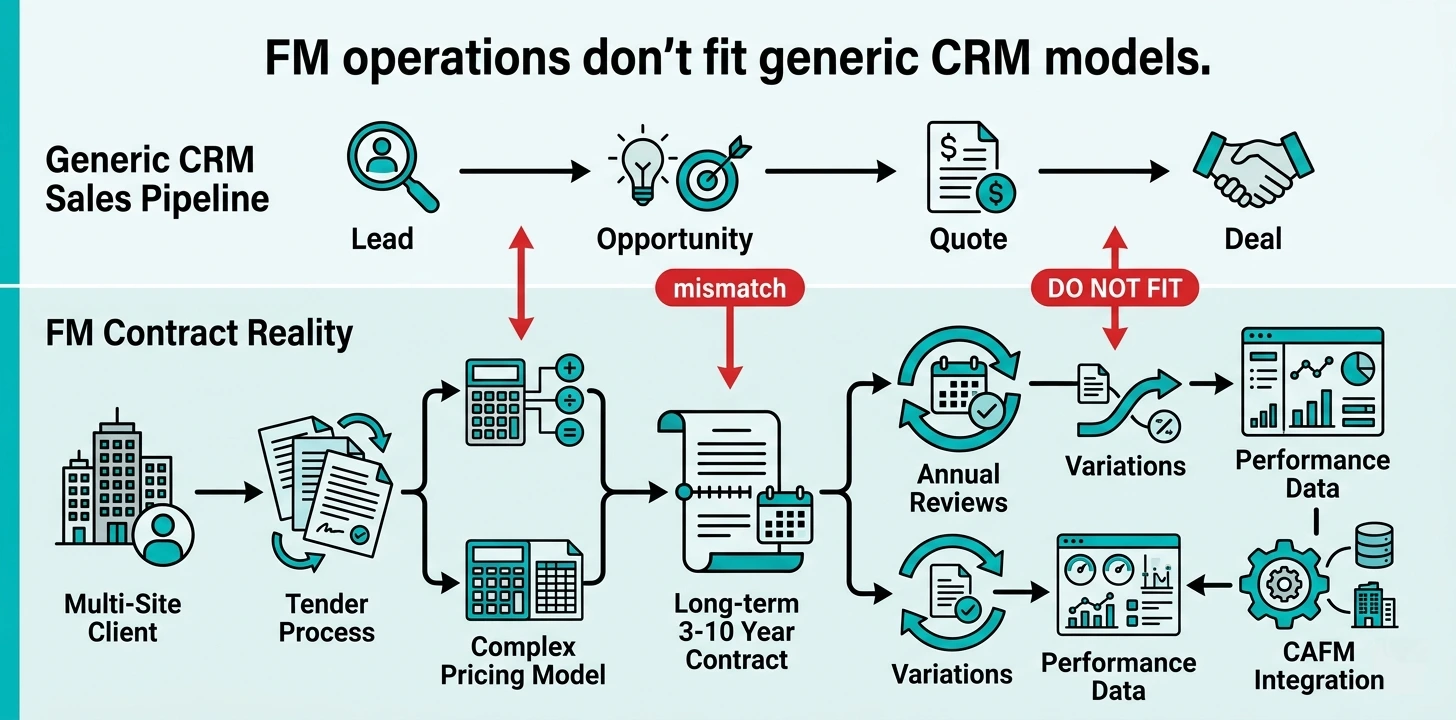
For FM contractors, the reality is more complex. Generic CRM platforms are designed for generic sales processes. They assume your sales cycle looks like: lead → opportunity → quote → closed deal. They assume your customer data fits into standard fields: company name, contact details, revenue, industry sector. They assume your reporting needs match what other businesses need: pipeline value, conversion rates, deal velocity.
But FM operations are not generic sales processes:
- Clients are not "leads" — they are multi-site contracts with dozens of individual buildings
- Opportunities are not simple deals — they are tender processes with staged submissions and months-long evaluation periods
- Quotes are not single-line items — they are complex pricing models tied to asset counts, service frequencies, and SLA tiers
- Client relationships span 3–10 year contract periods with annual reviews, variation orders, and scope changes
- Contract performance data must integrate with CAFM systems, finance packages, and operational dashboards
Generic CRM platforms can be configured to handle these requirements. But "configured" means months of customisation work, expensive consultants, ongoing licence costs for features you do not use, and a system that still feels like you are forcing your business into someone else's process model.
Why FM contractors are building bespoke CRM systems with Power Apps
The alternative to configuring a generic CRM platform is building a custom solution using Microsoft Power Apps and Dataverse. This is not "building from scratch" — it is using a low-code platform to create a CRM system designed specifically for how FM contractors actually operate.
Here is what changes when you build a custom Power Apps CRM instead of buying off-the-shelf:
The economic case is clear: a custom Power Apps CRM built for FM operations costs less to deploy than configuring Salesforce or Dynamics 365 Sales for the same purpose, operates on lower ongoing licence costs, and delivers a system that matches your process rather than forcing you to adapt to a generic model.
Core modules every custom FM CRM should include
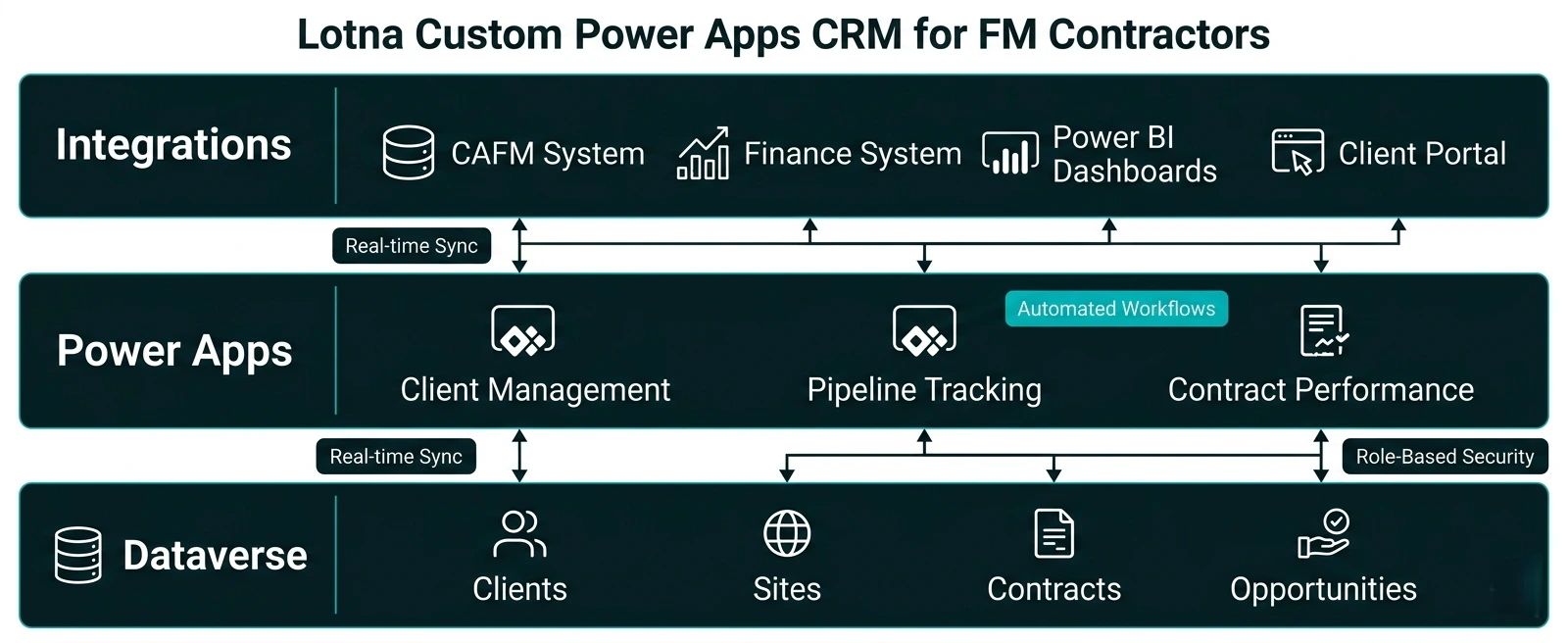
A properly designed Power Apps CRM for FM contractors is not a simplified version of Salesforce. It is a purpose-built system that handles the specific data structures, workflows, and reporting requirements of facilities management operations. These are the core modules:
Client and site hierarchy management
Multi-tier data structure: Client organisation → Contracts → Sites → Buildings → Assets. One client may have 15 contracts across 120 sites. The CRM must handle this hierarchy natively, not force it into a flat "account" structure. Engineers need to see which sites belong to which contract, which assets are covered by which SLA, and which contract manager owns each relationship.
Tender and opportunity pipeline
Track tenders from initial expression of interest through PQQ, ITT submission, clarification rounds, final pricing, and award decision. Each stage has specific documents, deadlines, and approval gates. The CRM captures submission history, bid/no-bid decisions, win/loss reasons, and feeds data back into future pricing models. Integrates with document libraries in SharePoint for tender documentation.
Contract value and performance tracking
Track annual contract value, margin, renewal dates, and variation orders. Link to live operational data from CAFM systems showing SLA performance, reactive job volumes, and PPM completion rates. Contract performance dashboards visible to account managers and senior leadership. Automated alerts 6 months before renewal with win/loss risk scoring based on recent performance data.
Client portal integration
Client-facing portal showing real-time job status, SLA compliance, asset registers, and compliance certificates. Built using Power Pages or embedded Power BI dashboards. Clients log in to see their data without requiring CRM access. Reduces "where is my job?" queries and improves client satisfaction by providing transparency.
CAFM and finance system integration
Bi-directional sync between CRM, CAFM, and finance systems. Contract data flows from CRM to CAFM when contract awarded. Operational performance data flows from CAFM to CRM for account manager visibility. Invoice data flows from finance system to CRM for margin analysis. All automated using Power Automate — no manual data transfer.
These modules are not "customisations" — they are the baseline requirements for an FM CRM. Off-the-shelf platforms require extensive configuration to deliver this functionality. A custom Power Apps solution builds them in from the start.
Real-world costs: custom Power Apps CRM vs Salesforce implementation
The total cost of ownership over three years tells the full story. Here is a like-for-like comparison for a 50-employee FM contractor implementing a CRM to manage 80 client contracts:
- Licences: 15 users × £75/month × 36 months = £40,500
- Implementation consultant: 60 days × £800/day = £48,000
- Custom integrations: CAFM connector + finance sync = £15,000
- Training: 3 sessions × £2,500 = £7,500
- Ongoing support: £500/month × 36 months = £18,000
- Annual price increases: ~7% year-on-year licence inflation
- Total 3-year cost: £129,000+
- Build cost: Fixed £28,000 (8 weeks, fully scoped)
- Licences: Included in Microsoft 365 E3 (already paying)
- Additional Power Apps licences: 5 users × £8/month × 36 months = £1,440
- Integrations: Included in build (Power Automate connectors)
- Training: Included in build cost
- Post-deployment changes: £200/month avg × 36 months = £7,200
- Total 3-year cost: £36,640
Cost saving: £92,360 over three years. The custom Power Apps CRM costs 72% less than a Salesforce implementation delivering equivalent functionality for FM operations. The saving increases further when accounting for Salesforce's year-on-year licence inflation and the fact that most FM contractors already pay for Microsoft 365, meaning the Power Apps licences represent marginal additional cost rather than a completely new software budget line.
Typical Build Time
From scoping to production deployment for a full FM-specific Power Apps CRM
Cost Reduction
Custom Power Apps CRM vs equivalent Salesforce implementation over 3 years
Build Cost Range
Typical fixed-price for complete FM CRM including training and documentation
When you should buy off-the-shelf instead of building custom
Custom Power Apps CRM is not the right answer for every FM contractor. There are scenarios where buying an off-the-shelf platform makes more sense:
You already use Dynamics 365 Sales. If your business already has Dynamics 365 Sales deployed and staff trained on it, the marginal cost of extending it for FM-specific requirements may be lower than building a separate Power Apps CRM. The platforms share the same Dataverse data layer, so integration is seamless. In this scenario, configure what you have rather than build new.
You have no technical resource internally. Custom Power Apps CRM assumes you either have someone internally who can manage the platform long-term, or you are willing to engage a Power Platform partner for ongoing support. If you have no internal IT capability and no appetite for external support relationships, a fully-managed SaaS platform with vendor support may be less risky.
You need marketing automation or e-commerce. Power Apps CRM excels at operational client management and contract tracking. It does not compete with Salesforce or HubSpot for marketing automation, email campaigns, or e-commerce integrations. If your primary requirement is lead generation and nurture campaigns rather than contract management, off-the-shelf marketing platforms are the better fit.
Addressing the "buy don't build" objection
The default corporate instinct is "buy, don't build" — based on decades of painful custom software projects that ran over budget, missed deadlines, and became unmaintainable. The objections to custom-built CRM are predictable and mostly outdated:
"Custom builds always go over budget and miss deadlines"
Reality: Low-code platforms like Power Apps have fundamentally changed build economics. Fixed-scope, fixed-price builds of £15K–£35K are standard. 8–12 week delivery timelines are realistic because you are configuring a platform, not writing code from scratch. The risk profile is not comparable to custom development projects of the 2000s.
"We will be locked in to one developer who built it"
Reality: Power Apps is a Microsoft platform with thousands of certified developers globally. If your original developer disappears, any Power Platform partner can pick up and support the system. The platform itself is supported by Microsoft, not by the individual who built your app. This is not the same as custom code that only one person understands.
"Off-the-shelf gets updates and new features automatically"
Reality: Salesforce updates give you features you do not need and often break customisations you have already paid for. Power Platform updates improve the underlying platform without touching your app logic. You control when and whether to adopt new features. "Automatic updates" are not always beneficial when they disrupt working systems.
"Custom builds lack the ecosystem of plugins and integrations"
Reality: Power Platform has 1000+ pre-built connectors covering every major business system. CAFM integration, finance system sync, and document management all use standard connectors. The "ecosystem" argument applied when building truly custom systems. Low-code platforms come with ecosystems built in.
"Our team will not be able to support or change it"
Reality: Power Apps is designed for business users, not just developers. Your operations manager can make form changes, add fields, and update workflows using visual designers. You are not locked into expensive consultants for minor changes. This is the core value of low-code — it democratises customisation.
"Salesforce is the industry standard for a reason"
Reality: Salesforce is the industry standard for *generic sales processes*. It became dominant before industry-specific requirements mattered and before low-code platforms existed. "Industry standard" is not the same as "best fit for FM operations." The question is not what most businesses use — it is what works best for your specific workflows.
How to scope and deliver a custom FM CRM in 10 weeks
Custom Power Apps CRM projects follow a proven delivery model. Most FM contractors complete full implementation in 8–12 weeks from initial scoping to production go-live. Here is the standard roadmap:
Requirements workshop
1–2 day workshop with stakeholders to map current CRM process, identify pain points, and define required modules and integrations.
Data model design
Design Dataverse schema for clients, sites, contracts, opportunities, and contacts. This is the foundation — get it right and everything else follows.
Build core modules
Build model-driven apps for client management, opportunity pipeline, contract tracking, and reporting dashboards using Power Apps and Power BI.
CAFM/finance integration
Build Power Automate flows to sync data between CRM, CAFM system, and finance package. Test data flow in both directions.
User acceptance testing
Deploy to test environment. Account managers and contract leads test with real client data. Refine based on feedback.
Data migration
Import existing client data from spreadsheets, legacy CRM, or CAFM system. Validate data quality and completeness.
Training and rollout
Train account managers, contract leads, and senior leadership. Deploy to production, run parallel with old system for 2 weeks.
Hypercare support
30-day post-deployment support to fix issues, add minor features, and ensure adoption. Hand over to internal team or ongoing support partner.
Fixed-price builds covering steps 1–8 typically cost £15K–£35K depending on complexity of integrations and number of custom modules required. Timeline is 8–12 weeks from contract signature to production deployment. This is faster and cheaper than Salesforce configuration projects delivering equivalent functionality.
The question is fit, not familiarity
The choice between off-the-shelf CRM and custom Power Apps is not a question of risk tolerance or technical capability. It is a question of fit. Does your business operate like the generic sales processes that Salesforce and HubSpot were designed for, or do you have FM-specific requirements that generic platforms force you to work around?
For most FM contractors managing multi-site client contracts, tender pipelines, and CAFM integration, the answer is clear: generic CRM platforms require expensive customisation to deliver what a purpose-built Power Apps CRM provides out of the box. The economics favour custom builds. The deployment timeline favours custom builds. The operational fit favours custom builds.
The "buy don't build" instinct made sense when custom software meant months of coding, unclear costs, and vendor lock-in. That world no longer exists. Low-code platforms have changed the equation entirely. Building a custom FM CRM in 2026 is lower risk, lower cost, and faster to deploy than configuring Salesforce to do the same job.
The businesses that recognise this are deploying CRM systems designed for how FM operations actually work — not systems designed for generic B2B sales that have been tortured into something vaguely suitable. The competitive advantage of having a CRM that matches your process rather than fighting against it compounds over years. By the time competitors catch up, you will be three contract cycles ahead.
Ready to replace your spreadsheets?
Book a free 60-minute discovery call and we will show you what is possible for your business.
Book a Discovery Call →