Why reactive maintenance is killing profitability in FM and manufacturing
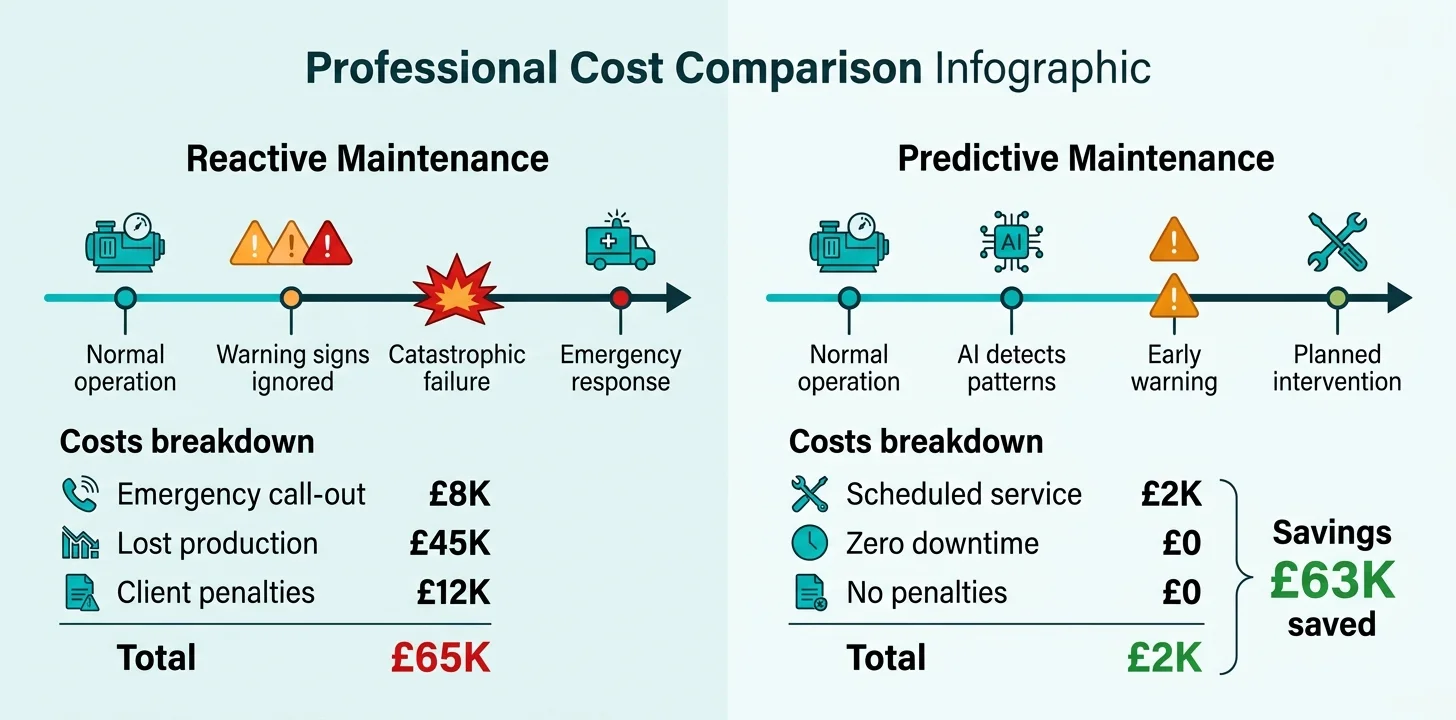
A manufacturing plant's primary production line fails at 2am on a Tuesday. Emergency engineer call-out. Expedited parts delivery. Production halted for 18 hours. Lost output: £45K. Repair costs: £8K. Client penalty clauses triggered. Total impact: £65K. The failure was preventable. The equipment had exhibited declining performance for six weeks. Vibration sensors showed increasing irregularity. Maintenance logs recorded three minor interventions in the preceding month. Every warning signal was present. Nobody connected the patterns until catastrophic failure occurred.
This scenario repeats across FM and manufacturing operations daily. Reactive maintenance is the default operating model: equipment fails, emergency response activates, expensive repairs commence. The business case for predictive maintenance has been understood for decades. The execution barrier has been converting maintenance history data into actionable failure predictions.
The cumulative cost of reactive maintenance extends beyond emergency repair bills:
- Emergency call-outs cost 3–5× planned maintenance rates due to urgency premiums and overtime
- Production downtime in manufacturing averages £2K–£15K per hour depending on facility
- Client SLA penalties triggered when FM contractors cannot restore critical systems within contracted timeframes
- Equipment lifespan reduced 20–40% when failures occur rather than planned component replacement
- Parts inventory carrying costs increase when stocking for emergency scenarios rather than planned maintenance
- Engineer productivity reduced by 30–40% when reactive firefighting replaces planned workflow
Traditional preventive maintenance (time-based servicing) addresses some scenarios but misses the majority. Boiler serviced annually in July still fails in November because time-based schedules ignore actual equipment condition and usage patterns. The missing capability is condition-based prediction: analysing equipment behaviour patterns to forecast failures before they occur based on actual degradation signals rather than arbitrary calendar schedules.
How AI analyses maintenance patterns to forecast equipment failures
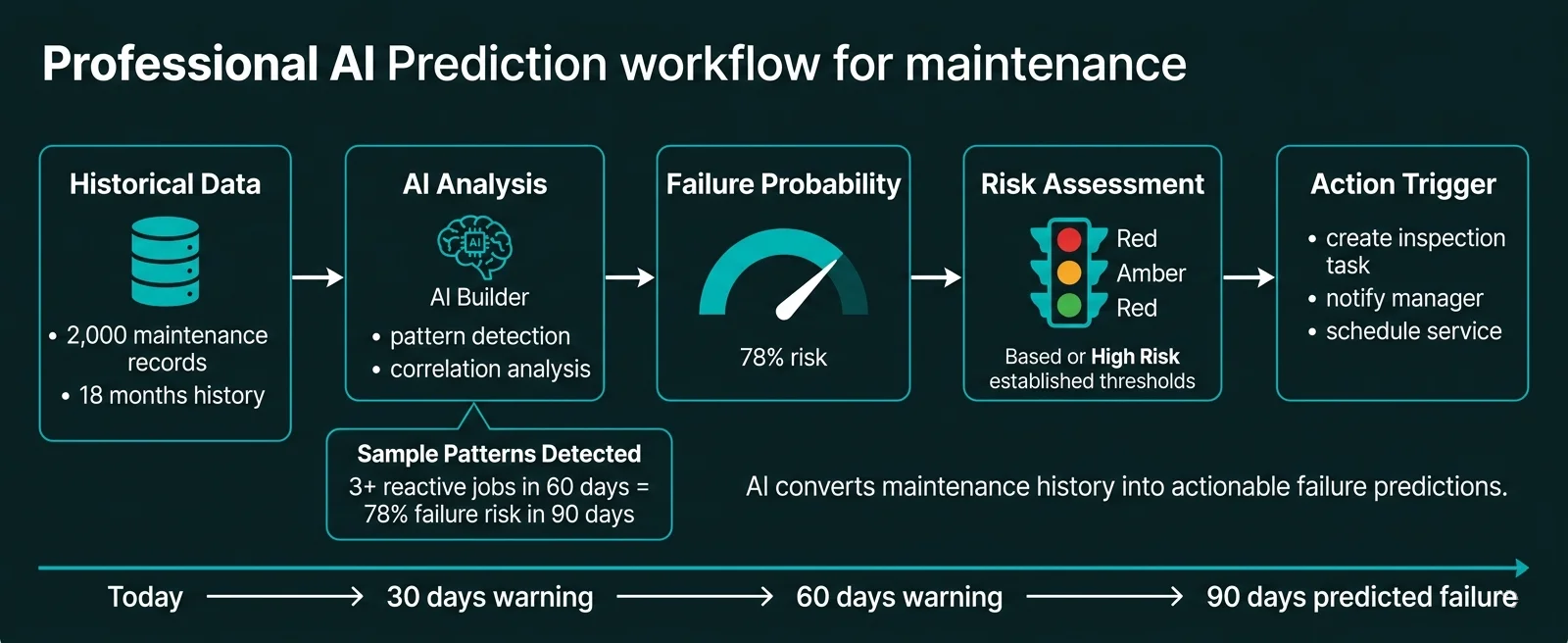
AI-powered predictive maintenance does not require IoT sensors, real-time telemetry, or complex infrastructure. It works with data you already have: maintenance history in CAFM systems, job completion records, parts replacement logs, and engineer site notes. Power Platform AI Builder analyses this historical data to identify patterns that precede failures.
Here is what changes when you deploy AI failure prediction:
- Boiler serviced every 12 months regardless of condition
- Service performed in July as scheduled
- Technician reports "no issues found, all within tolerance"
- Boiler fails in November (4 months after service)
- Emergency call-out, tenant complaints, expensive repair
- Failure could not be predicted from calendar schedule alone
- Pattern invisible: boiler actually needed service based on usage, not date
- AI analyses 3 years of maintenance history for 200 similar boilers
- Identifies pattern: boilers with 2+ minor call-outs within 90 days have 82% probability of major failure within next 60 days
- This specific boiler: 3 call-outs in past 75 days (pressure issues, intermittent heating)
- AI flags asset as high-risk in October, 30 days before predicted failure
- Account manager notified, preventive inspection scheduled
- Faulty component identified and replaced during planned visit
- Failure prevented, emergency avoided, client relationship protected
The AI does not need to understand thermodynamics or mechanical engineering. It identifies statistical patterns: when equipment exhibits behaviour pattern X, failure outcome Y occurs within timeframe Z with probability P. The pattern might be "3+ reactive jobs within 60 days", "increasing time between PPM visits", "specific fault codes appearing in sequence", or "parts replacement frequency acceleration". The AI finds correlations humans miss because humans cannot analyse thousands of equipment lifecycles simultaneously.
Five high-value predictive maintenance applications across FM and manufacturing
AI-powered failure prediction delivers greatest return when applied to high-consequence equipment where failure causes significant business impact. These are the five scenarios FM and manufacturing operations deploy first:
HVAC system failure prediction (FM)
AI analyses 24+ months of reactive maintenance history for heating/cooling systems across portfolio. Identifies pattern: sites with 3+ temperature-related complaints within 60-day period have 78% probability of complete HVAC failure within 90 days. Flags high-risk assets automatically, creates preventive inspection tasks, alerts account managers. Prevents winter heating failures that trigger emergency call-outs and client escalations.
Production line component degradation (Manufacturing)
AI monitors maintenance records for critical production equipment. Pattern identified: motors requiring lubrication service twice within 120 days have 85% probability of bearing failure within next 45 days. High-risk motors flagged for replacement during next planned downtime window. Component replaced proactively before failure. Production line availability maintained. Unplanned downtime eliminated.
Water system leak risk assessment (FM)
AI analyses plumbing reactive maintenance history. Pattern: buildings with 2+ minor leak repairs within 6 months have 72% probability of major water damage incident within next 12 months. High-risk sites flagged for comprehensive plumbing inspection. Deteriorating pipework identified before catastrophic failure. Major water damage incidents prevented, insurance claims avoided.
Electrical panel degradation tracking (FM/Manufacturing)
AI monitors electrical maintenance interventions. Pattern: panels requiring breaker replacement more than once within 18 months have 68% probability of complete panel failure within 24 months. High-risk panels scheduled for comprehensive electrical survey during next shutdown. Aging infrastructure identified before failure causes fire risk or production halt. Compliance and safety maintained.
Lift/elevator failure forecasting (FM/Construction)
AI analyses lift maintenance records across building portfolio. Pattern identified: lifts with 4+ entrapment incidents or door faults within 12 months have 81% probability of major failure requiring extended outage within next 6 months. High-risk lifts flagged for modernisation assessment. Proactive component replacement scheduled. Building accessibility maintained, liability risk reduced.
Shared pattern: All these scenarios use AI to identify equipment exhibiting failure precursor patterns based on historical data analysis. The AI flags high-risk assets 30–180 days before predicted failure. Operations teams schedule preventive interventions during planned maintenance windows rather than responding to emergency failures. The economic advantage is overwhelming: planned intervention costs 60–80% less than emergency repair plus downtime.
How to build AI failure prediction models using existing maintenance data
AI-powered predictive maintenance does not require hiring data scientists or implementing complex infrastructure. Power Platform AI Builder provides prediction model training using visual configuration and your existing CAFM/maintenance system data. The implementation path is accessible to operations teams:
Export historical maintenance data
Extract 18–36 months of maintenance history from CAFM system: asset ID, maintenance date, job type (reactive/PPM), fault description, parts replaced, cost, engineer notes. Include failure outcomes: which assets experienced major failures requiring >£5K repair or >24hr downtime. This historical dataset becomes your AI training data. Minimum 500 records recommended; 2000+ records ideal for higher accuracy.
Define prediction target and timeframe
Specify what you want to predict: "major HVAC failure within next 90 days" or "production line component failure within next 60 days". AI Builder requires binary outcome (yes/no failure) and prediction horizon (30/60/90 days). Clear definition improves accuracy. Example: "Predict probability this boiler will experience failure requiring >£3K emergency repair within 60 days."
Train prediction model using AI Builder
Upload maintenance history dataset to AI Builder. Select target column (failure yes/no). AI Builder automatically analyses patterns correlating with failures: reactive job frequency, time since last service, fault type patterns, parts replacement history. Model trains in 30–90 minutes. No coding required. AI Builder handles feature engineering, algorithm selection, and model optimisation automatically.
Validate accuracy with test dataset
AI Builder automatically reserves 20% of data for testing. Model predicts failures on test set. Accuracy reported: "Model correctly predicted 78% of failures 90 days in advance." Compare false positives (predicted failure, none occurred) versus false negatives (missed actual failure). Refine prediction threshold based on business tolerance. Conservative threshold (predict more failures) reduces missed failures but increases unnecessary inspections.
Deploy model and integrate into workflows
Publish AI Builder model. Create Power Apps interface or Power Automate workflow calling prediction model. Daily workflow: pull current asset data from CAFM → run through AI prediction model → flag assets with >70% failure probability → create inspection tasks → notify account managers. Predictions update automatically as new maintenance data accumulates.
Measurable ROI from AI-powered predictive maintenance
Predictive maintenance using AI delivers return on investment in four measurable areas:
Reduction in Emergency Call-Outs
Percentage decrease in unplanned reactive maintenance when high-risk assets receive preventive intervention before failure
Lower Maintenance Costs
Cost reduction from planned component replacement versus emergency repair including parts expediting and overtime premiums
Reduction in Downtime Hours
Decrease in unplanned equipment downtime when failures prevented through predictive intervention
Eliminated emergency response costs. Emergency call-outs cost 3–5× planned maintenance rates. Out-of-hours engineer: £120/hr versus £35/hr standard rate. Expedited parts delivery: £200 overnight versus £20 standard shipping. Two-day repair requiring emergency response: £2,800 versus identical repair during planned maintenance: £800. Predictive intervention eliminates urgency premium. Same technical work, 70% lower cost.
Production uptime protection in manufacturing. Unplanned downtime in manufacturing averages £3K–£12K per hour depending on facility and production line. 18-hour emergency repair = £54K–£216K lost output. Planned component replacement during scheduled shutdown: zero production impact. Single prevented production line failure pays for entire predictive maintenance implementation. Subsequent failures prevented deliver pure bottom-line gain.
Extended equipment lifespan. Equipment failing catastrophically experiences collateral damage beyond primary fault. Motor bearing failure damages rotor, housing, connected components. Replacement cost: £12K versus planned bearing replacement: £800. Reactive failures cascade into larger repairs. Predictive intervention isolates fault before propagation. Equipment lifespan extended 25–40% when major failures prevented through condition-based replacement.
Client relationship protection in FM. Emergency heating failure in December generates client escalation, penalty clauses, contract risk. Same failure prevented through October preventive intervention: zero client impact, relationship strengthened through proactive service. Contract renewal probability correlates strongly with failure prevention. Predictive maintenance converts reactive vendor into strategic partner. Retention improvement worth 5–10× direct maintenance cost savings.
Addressing the "we don't have enough data" objection
Every business considering AI predictive maintenance raises similar concerns. Here is what the objections sound like and what the reality is in 2026:
"We don't have enough historical data to train AI"
Reality: AI Builder prediction models work with 500+ records. Extract 18 months of maintenance history from CAFM system — typical FM contractor with 50 sites has 2000+ maintenance records. Manufacturing facility with 100 critical assets generates 1500+ service records annually. You have more data than you realise. It exists in your CAFM/CMMS already.
"Our maintenance data is too inconsistent"
Reality: AI models handle data inconsistency better than rule-based systems. Missing fields, inconsistent terminology, incomplete records all reduce accuracy but do not prevent training. Start with best-quality data subset (e.g., critical equipment only). Build model, validate accuracy, expand to messier data gradually. Perfect data is not required; sufficient data volume overcomes inconsistency.
"AI predictions will be wrong and waste money on unnecessary inspections"
Reality: You control prediction threshold and tolerate false positives versus false negatives trade-off. Conservative threshold: inspect assets with >60% failure probability (more inspections, fewer missed failures). Aggressive threshold: only inspect >85% probability (fewer inspections, higher miss rate). Start conservative, refine based on cost-benefit analysis. Even 70% accuracy delivers positive ROI when emergency call-out cost is 4× planned inspection.
"This requires expensive IoT sensors and real-time monitoring"
Reality: AI prediction works with maintenance history alone — no sensors required. IoT telemetry improves accuracy but is not prerequisite. Start with pattern analysis of existing CAFM data. Add IoT sensors later if ROI justifies investment. Many FM/manufacturing operations achieve 75–80% prediction accuracy using maintenance records only. Sensor data pushes accuracy to 85–92% but requires infrastructure investment.
"We need data scientists to build prediction models"
Reality: AI Builder provides visual model training interface. Operations manager can build prediction model after 2-hour training session. No Python, no statistics degree, no data science team. Upload data, define target, click train. Model built automatically. For complex scenarios, engage Power Platform partner for initial model build and knowledge transfer. Ongoing model refinement handled by operations team.
"Equipment is too diverse for one prediction model"
Reality: Build separate models per equipment category. HVAC prediction model trained on heating/cooling history. Production motor model trained on motor maintenance records. Electrical panel model trained on electrical interventions. Five equipment categories = five models. Each model optimised for specific failure patterns. AI Builder supports unlimited models. Train category-specific models in parallel.
How to deploy predictive maintenance in 6 weeks
AI-powered predictive maintenance follows proven implementation roadmap. Most FM and manufacturing operations deploy first prediction model within 5–6 weeks from scoping to production:
Identify highest-impact equipment category
Choose asset type where failure has greatest business consequence — typically HVAC for FM, production line components for manufacturing. Focus on equipment with >£5K failure cost or >12hr downtime impact.
Extract and prepare historical data
Export 18–36 months maintenance history from CAFM/CMMS. Include: asset ID, date, job type, fault description, cost, outcome. Label major failures (binary yes/no column). Minimum 500 records; 2000+ ideal. Clean obvious data errors.
Build and train AI prediction model
Upload dataset to AI Builder. Define prediction target: "Major failure within 90 days (yes/no)". Select relevant fields (job frequency, time since service, fault patterns). Train model. AI Builder reports accuracy on test set.
Validate accuracy and refine threshold
Review prediction results on test dataset. Analyse false positives (predicted failure, none occurred) versus false negatives (missed actual failure). Adjust probability threshold based on business tolerance. Test with operations team using real scenarios.
Build operational workflow integration
Create Power App or Power Automate workflow. Daily/weekly: pull current asset data → run through prediction model → flag high-risk assets (>70% failure probability) → create inspection tasks → notify account managers/maintenance planners.
Pilot with subset of assets
Deploy predictions for 10–20 highest-risk assets identified by model. Schedule preventive inspections. Track outcomes: failures prevented, false alarms, cost avoided. Refine threshold based on pilot results. Prove ROI before full deployment.
Scale to full equipment portfolio
Expand predictions to entire asset category. Integrate into standard maintenance planning workflow. Account managers/planners receive weekly high-risk asset reports. Preventive interventions scheduled automatically. Model retrains monthly as new maintenance data accumulates.
Expand to additional asset categories
Build prediction models for next equipment category using same methodology. Typical sequence: HVAC → plumbing → electrical → lifts → production equipment. Each subsequent model deploys faster — data extraction and workflow patterns established.
Most operations complete steps 1–7 for first prediction model in 5–6 weeks. Once methodology proven and team trained, subsequent asset category models deploy in 2–3 weeks. Full predictive maintenance coverage across 4–5 critical equipment types typically achieved within 4–5 months.
Reactive maintenance is no longer economically defensible
The capability to predict equipment failures 30–90 days in advance using existing maintenance data fundamentally changes the economics of FM and manufacturing operations. Emergency call-outs that cost 3–5× planned maintenance rates become preventable. Production downtime costing £3K–£15K per hour becomes avoidable. Equipment lifecycles extend 25–40% when catastrophic failures are intercepted through planned intervention.
The technology barrier has been removed. AI Builder provides prediction model training using visual configuration — no data science expertise required. The data already exists in CAFM and CMMS systems. The implementation timeline is weeks, not months. The ROI is measurable within first quarter when emergency response costs are eliminated and downtime hours reduced.
FM and manufacturing operations deploying AI-powered predictive maintenance in 2025–2026 gain permanent competitive advantages. Their maintenance costs run 40–60% lower than reactive competitors because planned intervention is cheaper than emergency response. Their equipment uptime exceeds industry benchmarks because failures are prevented rather than repaired. Their client relationships strengthen because proactive service replaces reactive firefighting.
The businesses waiting for "more mature" predictive maintenance technology or "better data quality" have already missed the window. Early adopters deployed prediction models in 2023–2024 and are now 18–24 months ahead in capability maturity. Their AI models improve continuously as new maintenance data trains more accurate predictions. The competitive gap widens every quarter.
Reactive maintenance in 2026 is a strategic choice to accept higher costs, lower uptime, and weaker client relationships when the alternative is proven, accessible, and economically overwhelming. Your competitors are already preventing the failures you are still responding to. The question is not whether AI-powered predictive maintenance delivers value — the question is how many more preventable failures your business will tolerate before deploying the capability that makes reactive maintenance obsolete.
Ready to replace your spreadsheets?
Book a free 60-minute discovery call and we will show you what is possible for your business.
Book a Discovery Call →